Breakfast cereals high in fiber sound like an easy, quick win for people trying to increase their fiber intake. This is especially true after being told that “more fiber” is the answer to constipation, bloating, or irregular bowel movements. However, many people reach for a high fiber cereal expecting relief. Instead, they end up with more gas, more bloating, and sometimes worse constipation than before. The good news is there are many options out there that provide good sources of fiber without wrecking your gut.

As a registered dietitian specializing in IBS and SIBO, I often get asked about how breakfast cereals high in fiber can fit into a gut healthy diet. In this post, we will cover why fiber type matters more than the number on the box. Then we will explore high fiber cereals that tend to be well tolerated and those that aren’t. Finally, we will cover simple ways to boost the fiber in almost any bowl of cereal you already enjoy.
This post contains affiliate links. If you make a purchase through one of these links, I may earn a small commission at no additional cost to you. I only recommend products I have researched and would genuinely suggest to my own clients.
Why Fiber Type Matters More Than the Amount
Fiber is not one single nutrient, even though it gets marketed that way on cereal boxes. There are two broad categories, soluble and insoluble, and they behave in different ways once they reach the digestive tract.
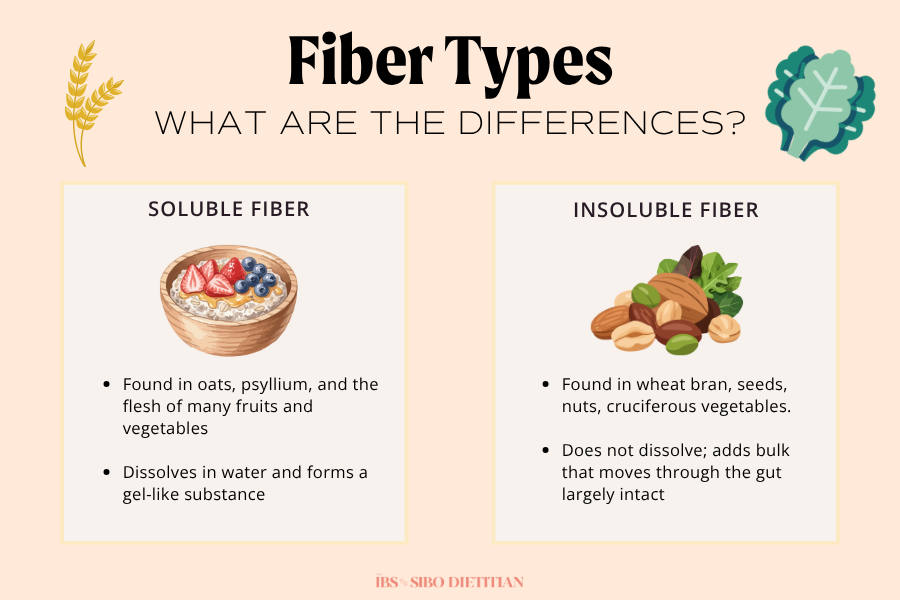
Soluble fiber:
- Found in oats, psyllium, and the flesh of many fruits and vegetables
- Dissolves in water and forms a gel-like substance
- Generally gentler and slower to ferment in a sensitive gut
Insoluble fiber:
- Found in wheat bran, corn bran, and many wheat-based cereal products
- Does not dissolve; adds bulk that moves through the gut largely intact
- Often highly fermentable (especially wheat bran) and more likely to trigger gas and bloating in a sensitive gut
This is important to note because many high fiber cereals rely heavily on wheat bran. Wheat bran contains fructans, a fermentable oligosaccharide that falls under the FODMAP umbrella. When fructans and other fermentable fibers reach the colon largely undigested, gut bacteria rapidly ferment them. This produces gas as a byproduct (Bertin, Zanconato, Crepaldi, et al., Nutrients, 2024). People with IBS often have visceral hypersensitivity. This means the same amount of gas causes far more pain and bloating in someone with IBS. Someone without a sensitive gut would barely notice it (Bertin, Zanconato, Crepaldi, et al., Nutrients, 2024).

Join the Free Masterclass
Learn the real reason SIBO and IBS symptoms keep coming back, and what's actually missing from most protocols. No cost, no commitment.
Register NowIn a well-designed primary care trial, patients with IBS supplemented with either psyllium (a soluble fiber) or wheat bran. Those given psyllium saw significantly greater symptom improvement (Bijkerk, de Wit, Muris, Whorwell, Knottnerus, & Hoes, BMJ, 2009). This is one of the clearest examples in the research of why “just eat more fiber” is an oversimplified message. It simply does not hold up clinically.
High Fiber Cereals Worth Reaching For
These are the options I most often point clients toward when they want a high fiber breakfast that will not leave them doubled over with bloating.
- Plain rolled oats or steel-cut oats: (Quaker Old Fashioned Oats or generic brand) have around 4g of fiber per dry half cup serving. This is almost entirely soluble fiber. They are low FODMAP as long as no inulin, chicory root, or dried fruit is added.
- Barbara’s Original Puffins have about 6 grams of fiber per serving from a corn and oat flour base. The Original and Peanut Butter flavors are considered low FODMAP. I would still double check the ingredient label on flavored varieties. “Natural flavor” can occasionally hide a high FODMAP ingredient.
- Bob’s Red Mill Organic Creamy Buckwheat Hot Cereal is naturally gluten free and low FODMAP. It makes a nice higher fiber alternative to oatmeal for clients who want variety.
- goodMix Superfoods Blend 11 is a seed and superfood blend (chia, flax, buckwheat, pumpkin seeds). It is Monash University certified low FODMAP. It provides a meaningful fiber boost when sprinkled over a base cereal rather than eaten as a stand-alone bowl.
- Nature’s Path Flax Plus Organic Pumpkin Flax Granola Breakfast Cereal is a whole grain blend. It combines organic flaxseed, whole grain oats, and pumpkin seed. It is crispy, naturally sweetened, and offers 5 grams of fiber per serving.
- General Mills Cheerios come in several low FODMAP flavors, including original, multigrain, and cinnamon oat crunch. Most varieties contain between 3 and 4 grams of fiber per serving.
Cereals High in Fiber That Can Frequently Backfire
Many popular high fiber cereals lean heavily on chicory root fiber or inulin to boost their fiber count on the nutrition label, and both are concentrated sources of fructans, one of the most fermentable FODMAP categories there is. Even small amounts, as little as half a gram to a gram, can be enough to trigger gas, bloating, cramping, and irregular bowel movements in someone with IBS.
- Fiber One (most varieties): leans heavily on chicory root extract to hit its high fiber numbers, making it one of the more concentrated fructan sources on the cereal aisle and a common bloating trigger.
- Kashi (many varieties): several Kashi cereals list chicory root fiber or inulin among the first few ingredients, so the fiber count looks impressive on the label while the fiber itself is still highly fermentable.
- Catalina Crunch (most varieties): Although Catalina crunch has a whopping 9g fiber per serving, Catalina flour contains a combination of a number of high FODMAP ingredients such as chicory root fiber and pea protein.
- Any cereal or granola listing “inulin,” “chicory root,” or “chicory root fiber” high on the ingredient list: these are added specifically to boost the fiber grams cheaply, not because they are gentle on a sensitive gut.
- High-FODMAP dried fruit add-ins (raisins, dried apple, dried mango, dates): common in “healthy” granolas and clusters, these stack a second fermentable load on top of any bran or inulin already in the mix.
The problem is not that fiber itself is the enemy. It is that chicory root, inulin, and high FODMAP dried fruit are cheap ways to boost the numbers on the label, not signs that a cereal is gentle on a sensitive gut. Reading the ingredient list, not just the fiber grams, is the single most useful habit I teach clients when they are cereal shopping.
How to Boost the Fiber in Any Cereal You Already Eat
If you already have a cereal you enjoy and tolerate well, whether that is corn flakes, rice cereal, or plain Cheerios, you do not need to give it up. You can build meaningful fiber on top of it with a few gut-friendly add-ins.
- Ground flaxseed: start with one tablespoon and work up to two, which adds roughly two to four grams of soluble fiber
- Psyllium husk: start with a half teaspoon stirred into milk or a dairy alternative, and increase slowly while making sure you are drinking enough water alongside it
- Chia seeds: keep this one to one tablespoon to start, and let sit in the milk for a few minutes to let it bloom.
- Hemp hearts: a lower fiber but easily tolerated add-in that also brings in protein and omega-3s without adding fermentable load
- Low FODMAP Fruits: add a variety of low fodmap fruits such as strawberries, blueberries, raspberries, kiwis, and/or bananas to add flavor and additional fiber! Just make sure you are mindful of your portions.
Starting with one add-in at a time and increasing slowly over one to two weeks gives your gut a chance to adjust without overwhelming it with fermentable material all at once.

Conclusion
If breakfast cereals high in fiber have been making your symptoms worse instead of better, the goal should not simply be to avoid fiber altogether or push through the discomfort assuming it will resolve on its own. Choosing a cereal built on soluble, well-tolerated ingredients, watching out for chicory root and inulin on the label, and building fiber gradually with add-ins like flax and psyllium gives you a practical, sustainable way to support your gut without chasing a number on a nutrition label.
Frequently Asked Questions
Is all fiber bad for IBS?
No, and this is one of the most common misconceptions I address in practice. Soluble fiber, particularly from oats and psyllium, has strong research support for improving IBS symptoms. Often times insoluble, highly fermentable fiber from sources like wheat bran is more likely to worsen bloating and discomfort (Bijkerk, de Wit, Muris, Whorwell, Knottnerus, & Hoes, BMJ, 2009). The goal is never to eliminate fiber, but to choose the type and amount that your gut can comfortably process.
Is Fiber One or Kashi cereal low FODMAP?
Most Fiber One and many Kashi varieties rely on chicory root fiber or inulin to boost their fiber count. They both are also concentrated fructans that are not low FODMAP. Even small amounts can trigger gas and bloating in someone with IBS. I generally steer clients toward oat, buckwheat, or corn-based cereals instead and checking the ingredient list for high FODMAP ingredients.
What is the best high fiber cereal for someone with IBS?
Plain oat-based cereals, such as rolled oats or steel-cut oats without added inulin, chicory root, or high-FODMAP dried fruit, tend to be the best-tolerated option for most people with IBS. Barbara’s Original Puffins and Bob’s Red Mill Organic Creamy Buckwheat Hot Cereal are two other options I frequently recommend. Reading the ingredient list is key, since two cereals with identical fiber grams can behave differently in the gut depending on the fiber source.
Can I just add fiber to my usual cereal instead of switching brands?
Yes, and this is often the simplest solution I offer clients. Adding small amounts of ground flaxseed, pysllium husk, or fruit to a cereal you already tolerate can increase soluble fiber intake without changing cereal. The key is starting low and increasing gradually so your gut has time to adjust.
How much fiber should someone with IBS eat per day?
Most evidence-based guidelines recommend building toward roughly twenty five to thirty five grams of fiber per day. It is best to prioritize a slow, gradual increase to avoid triggering gas and bloating. (McKenzie, Bowyer, Leach, et al., Journal of Human Nutrition and Dietetics, 2016). The right target varies by individual, which is why working with a SIBO dietitian to personalize fiber type and pacing is often more effective than following a generic recommendation.
Should I avoid fiber completely if I have SIBO?
Not necessarily, though moderating highly fermentable fiber intake during active SIBO treatment can help reduce symptom flares while the underlying bacterial overgrowth and motility dysfunction are being addressed. The goal should not ever be long-term fiber avoidance, since fiber plays an important role in feeding a healthy microbiome and supporting regular bowel movements once the gut has had a chance to heal. This is best approached as a temporary, targeted adjustment rather than a permanent restriction.