With juicing becoming increasingly popular, is celery low FODMAP? is a question I get asked often. Many come to me dealing with bloating, cramping, or unpredictable bowel changes after drinking celery juice or chomping on a celery stick from a charcuterie board. Often, they have been told that celery is a safe, gut friendly vegetable with no caveats attached.
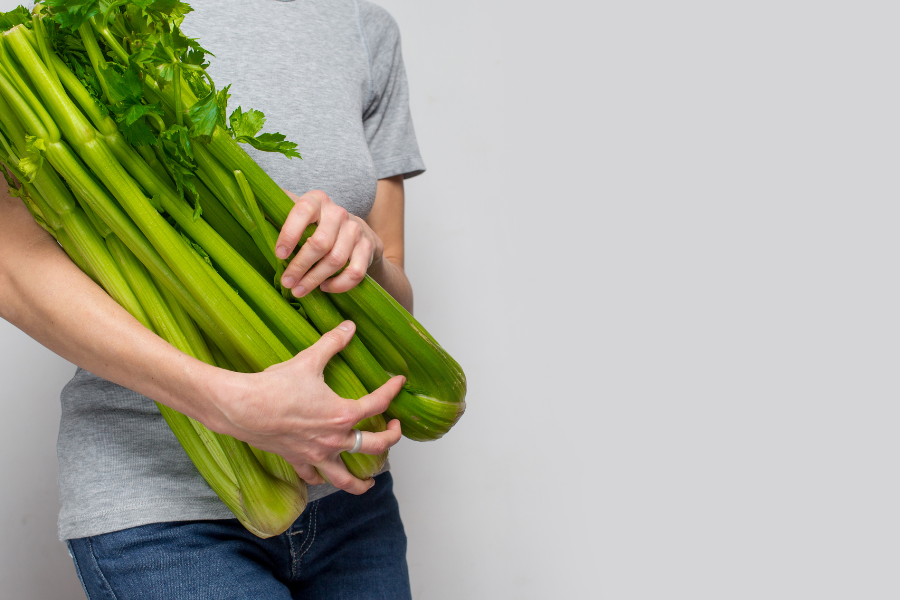
As a registered dietitian specializing in IBS and SIBO, clients often ask me about celery and the low FODMAP diet. They feel confused about why a food marketed as a diet staple and juice cleanse favorite can still cause symptoms. In this post, I will break down what actually makes celery a moderately high FODMAP food. I will explain how the body absorbs and ferments mannitol differently than other carbohydrates. I will cover safe serving sizes and common mistakes people make when adding celery back into their diet too. Finally, I will share practical swaps so you can keep enjoying flavor and variety no matter what stage of healing you are in.
What Makes Celery a FODMAP Concern?
FODMAP stands for fermentable oligosaccharides, disaccharides, monosaccharides, and polyols. These are short chain carbohydrates that the small intestine poorly absorbs. The gut then pulls them into the large intestine, where bacteria ferment them. In some, this fermentation leads to unflavorable symptoms. Research has consistently shown that lowering total FODMAP intake reduces bloating, pain, and irregular bowel habits in most people with IBS (Halmos et al., Gastroenterology, 2014). This is why the diet has become a first line strategy in IBS and SIBO management.
What is Mannitol?
Celery’s main offender is mannitol, a sugar alcohol that falls into the polyol category. Polyols are the smallest FODMAPs and the most osmotic. The small intestine only partially absorbs them, and the unabsorbed portion draws water into the bowel through osmosis while also fueling colonic bacteria.
That combination of extra fluid and extra gas tends to trigger cramping, urgency, or bloating in people whose gut is already sensitive. Research shows polyol malabsorption becomes more likely as the dose increases (Lenhart and Chey, Advances in Nutrition, 2017). This means a small amount of celery may sit fine while a larger portion does not.

Join the Free Masterclass
Learn the real reason SIBO and IBS symptoms keep coming back, and what's actually missing from most protocols. No cost, no commitment.
Register NowControlled feeding studies have shown that increasing the amount of fermentable short chain carbohydrates in a single sitting directly increases breath hydrogen production and symptom severity in people with IBS (Ong et al., Journal of Gastroenterology and Hepatology, 2010). This explains why a few bites of celery in a salad can feel totally different than a big glass of celery juice on an empty stomach.
Is Celery Low FODMAP? What the Research Actually Shows
So is celery low FODMAP or not? The honest answer is that it depends entirely on the the form and the portion.
Monash University has historically rated raw celery stalk low FODMAP in fairly small amounts, often cited as around one small stalk or a few tablespoons chopped. Monash has updated this threshold over time as testing methods improve.
More recent Monash testing allows for a larger low FODMAP serving of raw celery stalk, closer to half a medium stalk. This shows how much these numbers can shift as labs refine their methods. Because thresholds change, always double check the current Monash FODMAP app before eating a large serving of celery. This is the most reliable way to know your personal cutoff, rather than relying on older blog posts or outdated charts.
Different Celery Types: A Quick Comparison
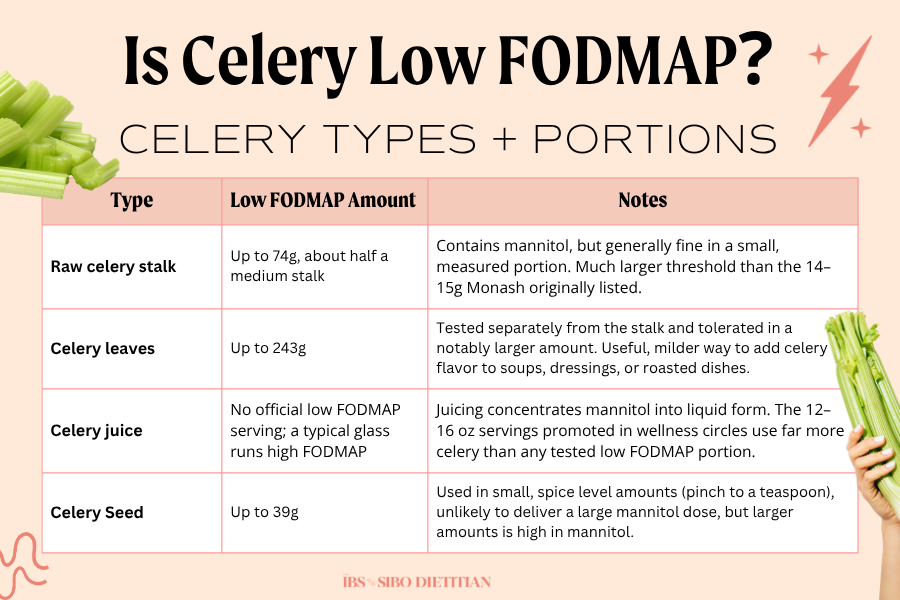
The form celery changes how much mannitol you actually get. This is why the same vegetable can be a non issue in one form and a trigger in another. Here is how the different forms compare, based on current Monash University testing (Monash FODMAP, 2025).
Raw Celery Stalk
Low FODMAP serving: Up to 74g, about half a medium stalk.
Raw celery stalk contains mannitol, but a small, measured portion is generally fine. This is a much larger threshold than the 14 to 15g Monash originally listed, a good reminder to check the current app rather than an older chart.
Celery Leaves
Low FODMAP serving: Up to 243g.
Monash tests leaves separately from the stalk. People tend to tolerate leaves in a notably larger amount, which makes them a useful, milder way to add celery flavor to soups, dressings, or roasted dishes without a large mannitol load.
Celery Juice
Low FODMAP serving: No official low FODMAP serving; a typical glass runs high FODMAP.
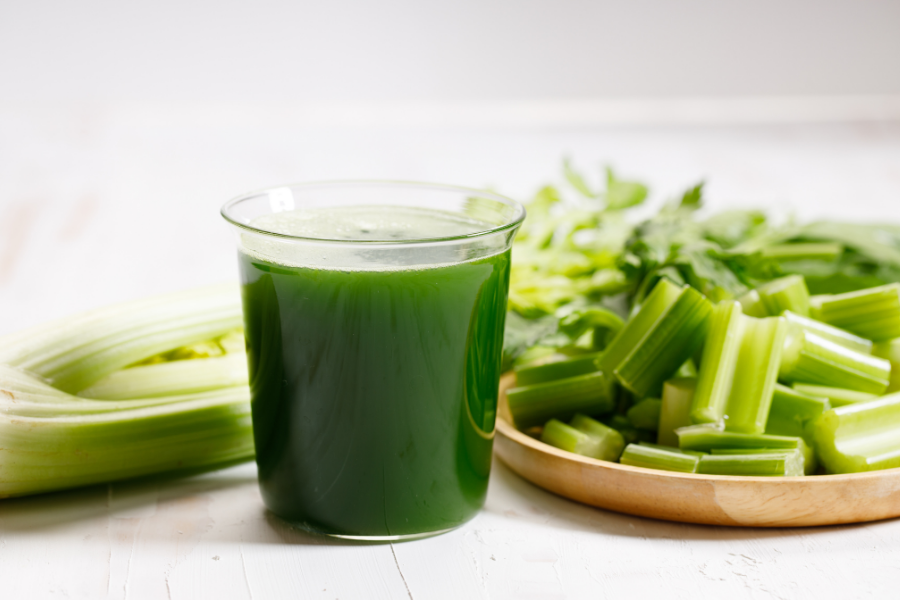
Juicing concentrates mannitol into liquid form. The 12 to 16 ounce servings promoted in wellness circles use far more celery than any tested low FODMAP portion. That concentration is what makes juice one of the easiest ways to unintentionally overshoot your dose.
Cooked Celery
Low FODMAP serving: Same as raw stalk, up to 74g.
Cooking does not meaningfully change the mannitol content, so the same portion guidance applies whether you eat celery raw or cooked into a dish. However, cooking your vegetables, high fiber or not, can make them easier to digest.
Celery Seed
Low FODMAP serving: Up to 39g.
Used in small, spice level amounts (teaspoon), celery seed is unlikely to deliver a large mannitol dose, but larger amounts are high in mannitol.
Common Mistakes People Make With Celery on a Low FODMAP Diet
Many people assume celery is automatically safe, without ever checking an actual serving size. Some also assume that because celery caused no symptoms once, they will always tolerate any amount. On the other end, some people avoid celery completely out of fear rather than testing an appropriate low FODMAP portion. This often leads to unnecessary dietary restriction rather than real symptom relief.
Beyond that mindset, a lot of the specific prep and products that circulate online as gut healthy advice can actually work against someone with IBS or SIBO:
- People often drink sixteen ounce celery juice cleanses, marketed as a morning detox ritual, on an empty stomach with no other food around to slow digestion. That delivers several times a low FODMAP serving of mannitol in one sitting.
- Celery based green smoothies combine celery with apple or mango, both of which bring their own FODMAP load through excess fructose.
- Pairing celery with other polyol containing foods, like mushrooms or cauliflower, in the same meal stacks the total FODMAP load higher than any single food alone.
What to Use Instead of Celery During the Elimination Phase
During the elimination phase, the goal is not to cut every fruit or vegetable out of your cooking. It is to lean on options that will not add excessive mannitol or other FODMAPs while you are working through symptoms.
Some well tolerated lower FODMAP swaps for celery include:
- Cucumber, for raw crunch in salads or as a snack
- Carrots, low FODMAP in any normal serving and a reliable base for soups and stir fries
- Green bell pepper, up to 75g, for crunch in salads or stir fries
- Bok choy stems, up to 75g, a mild, crunchy addition to stir fries and soups
- Water chestnuts or jicama, up to 75g, the closest texture match to raw celery’s snap
These give you the crunch, texture, and savory base celery usually provides, without the same concentrated mannitol load. If it is flavor you are looking for, simply using the celery leaves or seed is a good option as well. (Monash FODMAP, 2024 to 2025 update)
How to Add Celery Back In Without Triggering Symptoms
If you suspect celery has been part of your symptom pattern, this is the process I walk clients through.
Testing Your Personal Mannitol Threshold
Start reintroduction once you have followed the elimination phase for at least two weeks. Your symptoms should have improved enough that it would be obvious if a food is causing your symptoms over other factors. Celery falls into the mannitol polyol group. Testing it on its own, without other polyol foods in the same window, is one of the clearest ways to learn your personal mannitol threshold.
- Day 1: Trial about half a low FODMAP serving of raw celery stalk, roughly 37g, alongside a full meal that includes protein and fat. Eating any FODMAP alongside other food slows the rate it reaches the colon and often reduces symptoms.
- Day 2: Take a washout day with no celery and track how you feel. Gas related symptoms from polyols are not always immediate.
- Day 3: If you tolerated day 1 well, increase to a full low FODMAP serving, up to 74g, repeating the same food pairing.
- Day 4: Take another washout day and record your symptoms again. Some polyols require more than one washout day to fully clear.
- If both trials pass, you can consider celery reintroduced at a low FODMAP amount. If either trial was questionable or failed, note it and plan to retest later. Do not assume celery is permanently off the table. This is a dose dependent food, not a forbidden one.
If Symptoms Continue
If symptoms continue even at the day 1 half serving, that is a signal to look upstream at gut motility, bacterial overgrowth, or nervous system regulation. Do not assume celery itself is the sole problem. A dysregulated nervous system reduces digestive secretions and motility, which can amplify symptoms from any FODMAP, including celery. Supporting the vagus nerve and nervous system regulation is often just as important as the food itself. This is also where working with a registered dietitian to personalize your pace matters. A generic timeline rarely accounts for how much your own gut has already healed.
Final Thoughts: Celery and the Low FODMAP Diet
If you are dealing with symptoms after eating celery, the goal should not simply be to cut it out and move on. Celery is a dose dependent food rather than a forbidden one. The same portion awareness that applies here often applies across the rest of a low FODMAP plan. Once you understand how mannitol behaves and where your own threshold sits, celery becomes something you can work with intentionally. It is no longer something you avoid out of uncertainty.
Getting there usually requires a more comprehensive approach focused on digestion, gut motility, and nervous system regulation. It is not a pattern of eliminating food after food without ever getting to the root cause of why your gut reacts the way it does. Celery is rarely the whole story. It is one data point that, alongside how you respond to other polyols, fructans, and fructose, helps build a clearer picture of what your gut actually needs to heal.
Frequently Asked Questions
Is celery a high FODMAP vegetable?
Celery does not count as a uniformly high FODMAP vegetable, but it is dose dependent because of its mannitol content. Most people following a low FODMAP diet tolerate a small, measured serving regardless of where they are at in their journey. A large stalk or a full glass of celery juice, though, can move well into moderate or high FODMAP territory. This is why portion awareness matters more with celery than with a food that is either consistently low or consistently high FODMAP regardless of amount.
Can I eat celery if I have SIBO?
Many people with SIBO can tolerate a small portion of celery. Individual tolerance depends heavily on how significant the overgrowth is and how sensitive your gut currently feels. Because SIBO often involves both bacterial overgrowth and underlying motility dysfunction, the safest approach is to treat celery the same way you would any other polyol containing food. Start small, track your response, and adjust based on what you learn about your own threshold.
Does cooking celery reduce its FODMAP content?
Cooking celery does not meaningfully reduce its mannitol content. The same portion guidance applies whether it is raw, sauteed, or simmered into a soup. The main variable that changes with celery is the preparation. If your gut is in a sensitive state, cooked celery will be easier to digest than raw.
Is celery juice bad for people with IBS?
Celery juice itself is not inherently bad. The large volumes typically recommended in wellness trends, often twelve to sixteen ounces on an empty stomach, concentrate mannitol into a dose that is far above what most sensitive guts can comfortably tolerate. If you enjoy celery juice, there are ways to lower your risk of triggering symptoms. Try diluting it, drinking a much smaller amount, and pairing it with food rather than drinking it on an empty stomach.
How much celery is safe if I have IBS?
There is no single number that applies to everyone. Tolerance depends on the severity of your IBS, how sensitized your gut currently is, and what else is in your meal. A small, measured portion, such as a few tablespoons of chopped stalk, is a reasonable starting point for most people. From there, you can increase gradually if you tolerate that amount well over several exposures.