SIBO recurrence is something I see constantly in my practice. Many of my clients come in completely frustrated after finishing a round of antibiotics or herbal antimicrobials. They feel better for a few months, then watch their symptoms slowly creep back. They have done everything they were told to do. Yet here they are again, bloated, uncomfortable, and exhausted by the cycle. In most cases, SIBO is not coming back because the treatment failed. It is coming back because the root cause was never addressed in the first place.

As a Registered Dietitian specializing in IBS and SIBO, I often get asked why SIBO keeps returning after successful treatment. In this post, we will break down the most common reasons SIBO recurs. This includes how motility dysfunction, poor bile flow, and nervous system dysregulation all contribute to bacterial overgrowth. We will also cover what a more comprehensive approach to SIBO looks like. This will help you understand why lasting relief requires looking beyond antimicrobials alone.
SIBO Is a Symptom, Not the Root Cause
SIBO (small intestinal bacterial overgrowth) is not a disease in itself. It is a downstream consequence of dysfunction happening elsewhere in the digestive system. The bacteria that overgrow in the small intestine are not foreign invaders. They are normal gut bacteria that have migrated to a place where they do not belong. They are able to colonize there because something has broken down in the body’s natural defense system.
Although the bacteria is not inherently bad, it is customary to clear the bacteria using pharmaceutical antibiotics like rifaximin or herbal protocols. This addresses the overgrowth but not the more important question that is often left unanswered is why did the bacteria overgrow in the first place? This is why symptom management without root cause resolution almost always leads to relapse.
The Migrating Motor Complex: Your Gut’s Built-In Housekeeper
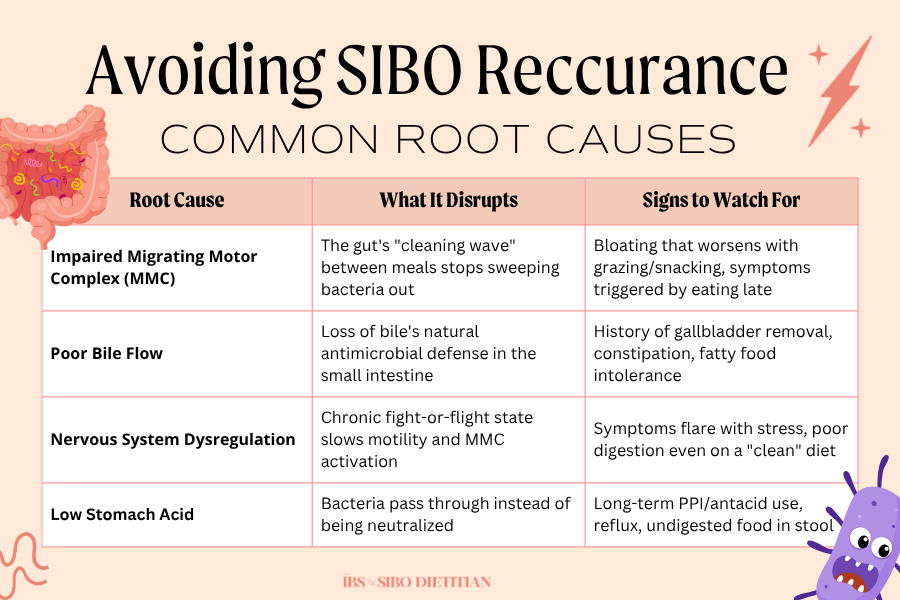
One of the key components in SIBO recurrence is the function, or lack there of the migrating motor complex, or MMC. The MMC is a cyclical pattern of electrical activity that sweeps through the small intestine between meals. It acts as a housekeeping mechanism, moving bacteria, food particles, and cellular debris toward the large intestine. Research has consistently shown that impaired MMC function is a primary driver of bacterial overgrowth in the small intestine (Pimentel et al., Digestive Diseases and Sciences, 2002).

Join the Free Masterclass
Learn the real reason SIBO and IBS symptoms keep coming back, and what's actually missing from most protocols. No cost, no commitment.
Register NowThe MMC only activates in a fasted state. This is why spacing meals 3 to 5 hours apart is often part of SIBO support protocols. Constant snacking, grazing throughout the day, or eating late at night all interrupt this process. The MMC never gets the uninterrupted time it needs to do its job. Over time, bacteria accumulate in the small intestine and overgrowth sets in. If we clear the overgrowth without addressing motility, the bacteria will simply return.
Poor Bile Flow and Its Role in SIBO Relapse
Another important part of your digestion to consider when treating SIBO is actually your liver, and more specifically the bile in your liver. Bile, produced by the liver and stored in the gallbladder, plays a critical role in both digestion and gut defense. Beyond its role in breaking down dietary fats, bile has natural antimicrobial properties that help regulate bacterial populations in the small intestine. This happens in part because conjugated bile acids activate the farnesoid X receptor (FXR) pathway in the ileum. Activating FXR triggers antimicrobial gene expression that keeps bacterial levels in check (Inagaki et al., Proceedings of the National Academy of Sciences, 2006). When bile flow is sluggish or bile quality is poor, the small intestine loses a key defense against overgrowth.
This is something I see all the time in practice, particularly in clients who have had their gallbladder removed. It is also common in those who struggle with constipation or have a history of liver stress. Sluggish bile flow is rarely the first topic of discussion, if ever addressed at all in conventional SIBO treatment, yet it can be a significant contributor to relapse.
Supporting bile production and flow often involves targeted nutritional strategies, including but not limited to:
Taurine
This amino acid conjugates with bile acids to form taurocholate, one of the primary bile salts your liver uses to package and release bile. Taurine deficiency, which is common in those eating low protein or plant-heavy diets, can limit how much bile your body is able to produce in the first place.
Glycine
Like taurine, glycine is used to conjugate bile acids. It also supports phase II liver detoxification, which is responsible for neutralizing hormones, toxins, and metabolic byproducts so they can be safely excreted.
Bitter herbs
Herbs like dandelion, gentian, or artichoke leaf stimulate the vagus nerve and trigger cholecystokinin release, which signals the gallbladder (or the bile ducts, in those without a gallbladder) to contract and release bile. This is especially useful before meals, when bile flow needs to ramp up to meet incoming fat.
Beyond supplementation, a few other factors are worth addressing:
Sleep
Bile acid synthesis follows a circadian rhythm, and poor sleep disrupts the liver’s ability to regulate this process efficiently. Chronic disrupted sleep has also been linked to changes in bile acid composition that favor a less protective microbial environment.
Fat intake
Bile release is triggered by dietary fat. Diets that are chronically too low in fat, can actually reduce the stimulus for bile flow and make stagnation worse over time.
Movement
Regular physical activity supports gallbladder emptying and overall motility, both of which keep bile moving instead of concentrating and stagnating.
The Nervous System and the Gut-Brain Connection
Stress can make a huge impact on the function of your gut. The enteric nervous system (often called the second brain) directly regulates gut motility, digestive enzyme secretion, and MMC activation. The body can become chronically stuck in a sympathetic, fight-or-flight state due to ongoing stress, unresolved trauma, or nervous system dysregulation. When this happens, digestive function becomes significantly impaired.
Research has demonstrated that psychological stress directly slows intestinal transit and disrupts MMC activity (Mayer et al., Gastroenterology, 2014). This creates the exact conditions that allow bacteria to overgrow. A client can do everything right nutritionally and still continue relapsing. Addressing the gut-brain connection is often essential for long-term SIBO resolution. This can include nervous system support, stress reduction strategies, and sometimes working with a trauma-informed practitioner.
Low Stomach Acid: A Common Overlooked Contributor
The stomach is the first line of defense against bacteria entering the small intestine. Gastric acid has two main jobs that create an environment inhospitable to bacterial overgrowth, and when either one falters, SIBO risk goes up.
Neutralizing Bacteria
Stomach acid is acidic enough to kill most of the bacteria that come in with food and drink. This keeps bacterial counts low before anything moves further down the digestive tract. Without adequate acid, bacteria that would normally be destroyed, survive the trip through the stomach and go on to populate the small intestine, where they don’t belong in large numbers.
Aiding Enzyme Activity and Digestion
Gastric acid also activates pepsin, the enzyme responsible for breaking down protein, and helps trigger the release of digestive enzymes further down the line. When food isn’t broken down properly in the stomach, larger, undigested particles move into the small intestine. That undigested material becomes fuel for bacteria, feeding overgrowth rather than being absorbed the way it should be.
Stomach acid can become insufficient due to chronic stress, the use of proton pump inhibitors (PPIs), or simply aging. When this happens, both protective functions break down at once. Bacteria go unchecked and food goes underprepared, creating exactly the conditions SIBO needs to take hold.
PPIs are one of the most common culprits I see in practice. It is far too common that people are leaving doctor’s offices with an acid reducing medicine in order to manage sour stomach or reflux. A meta-analysis of nineteen studies found that long-term proton pump inhibitor use significantly increases the risk of SIBO compared to nonuse (Lo & Chan, Clinical Gastroenterology and Hepatology, 2013).

What a More Comprehensive Approach Looks Like
If you are dealing with recurring SIBO, the goal is not to just repeat treatment every time symptoms return. There is much more to consider. It is important to understand which underlying systems may be contributing. This helps the body function more efficiently, so bacterial overgrowth becomes far less likely to return.
A comprehensive approach typically involves:
- Assessing and supporting motility and MMC function
- Addressing bile flow and liver health
- Evaluating nervous system regulation
- Restoring stomach acid where appropriate
- Ensuring the body is adequately nourished throughout the healing process
The body needs sufficient nourishment, proper digestive function, and a nervous system that feels safe enough to heal.
Conclusion
Recurring SIBO is not a sign that healing is impossible. It is a signal that the root cause has not yet been fully addressed. Shifting the focus from simply eliminating bacteria to understanding why they were able to overgrow in the first place changes everything. The path forward becomes much clearer. True resolution requires looking at motility, bile flow, stomach acid, nervous system regulation, and overall nourishment, not just the bacteria themselves.
If you’ve been through round after round of treatment and still feel stuck, you don’t need another antimicrobial protocol. You need a plan that actually maps your specific root causes. That’s exactly what the Root Cause Roadmap Session is for: a 75-minute 1:1 deep dive into your full health and diet history, prior labs and testing, and current diet and supplements, so we can pinpoint what’s actually driving your symptoms. You’ll leave with personalized guidance and a written roadmap for your next steps. Book Your Root Cause Roadmap Session
Frequently Asked Questions
Can SIBO come back after successful treatment?
Yes, and unfortunately this is very common. SIBO recurrence does not mean treatment failed. In most cases, it means the underlying conditions that allowed bacterial overgrowth were not adequately addressed alongside the antimicrobial protocol. This includes impaired motility, poor bile flow, and nervous system dysregulation. Clearing the overgrowth without resolving root causes creates the same environment for bacteria to return.
Is it normal for SIBO to keep coming back?
While SIBO recurrence is unfortunately common, it is not something that should be accepted as inevitable. Frequent relapse is a sign that a deeper investigation into motility, digestion, and systemic contributors is needed. Many clients who have experienced repeated SIBO episodes find lasting relief once root cause factors are identified and addressed comprehensively.
Does stress cause SIBO to come back?
Chronic stress significantly impairs the migrating motor complex and slows intestinal transit. This creates conditions that allow bacteria to accumulate in the small intestine. This is why nervous system regulation is an important but frequently overlooked component of SIBO treatment. Stress management is not just a lifestyle recommendation. It is a physiological necessity for long-term gut healing.
What is the migrating motor complex and why does it matter for SIBO?
The migrating motor complex is a pattern of muscular contractions that sweeps through the small intestine between meals. It clears bacteria and debris toward the large intestine. When this mechanism is impaired, bacteria are able to accumulate and overgrow. Supporting MMC function through meal spacing and motility-supportive strategies is important. It is also one of the most commonly overlooked aspects of SIBO prevention.