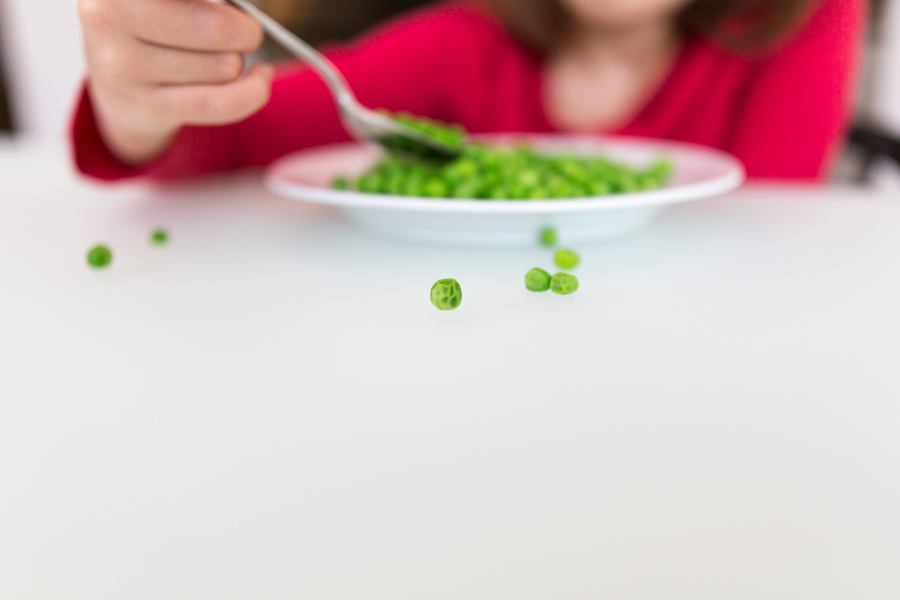
Peas are a great versitile option to add to the diet as a higher fiber plant protein source. Because of this, I often get asked are peas low FODMAP? There are so many variations of peas, making it confusing as to which types are low FODMAP and what will leave you bloated and gassy.
As a registered dietitian specializing in IBS and SIBO, I often get asked about peas and the low FODMAP diet. This is especially true when clients are trying to increase plant protein or fiber. Unfortunately though, unlike most vegetables, peas fall into the same carbohydrate family as other legumes. In this post, we will break down what GOS actually is and where it is found in the low FODMAP diet. We will also cover safe serving sizes for fresh, frozen, and canned peas. Then we will discuss practical swaps so you can still enjoy peas without guessing your way into a flare.
What Makes Peas a FODMAP Concern?
FODMAP stands for fermentable oligosaccharides, disaccharides, monosaccharides, and polyols, a group of short chain carbohydrates that pass through the small intestine largely undigested and ferment in the colon. Research has consistently shown that lowering total FODMAP intake reduces bloating, pain, and irregular bowel habits in most people with IBS (Halmos et al., Gastroenterology, 2014).
Oligosaccharides: Fructans and GOS
The oligosaccharide category, the O in FODMAP, splits into two subtypes: fructans and GOS. Both are chains of sugar molecules the small intestine cannot break apart, so they travel to the colon largely intact (Gibson and Shepherd, Journal of Gastroenterology and Hepatology, 2010).
Common fructan sources include:
- Wheat, rye, and barley
- Onion and garlic
- Asparagus and artichokes
- Certain fruits, including nectarines and watermelon
Common GOS sources include:
- Legumes and pulses, including lentils, chickpeas, and beans
- Peas, including split peas
- Some nuts, including cashews and pistachios
Peas fall on the GOS side of that split, which is why they behave more like lentils and chickpeas than like a typical low FODMAP vegetable. GOS is also dose dependent: larger amounts consumed at once directly increase breath hydrogen and symptom severity, which is why a small spoonful of peas in a stir fry can feel very different from a full cup served as a side dish (Ong et al., Journal of Gastroenterology and Hepatology, 2010).

Join the Free Masterclass
Learn the real reason SIBO and IBS symptoms keep coming back, and what's actually missing from most protocols. No cost, no commitment.
Register NowThe reason this affects people with IBS more than others comes down to visceral hypersensitivity. People with IBS have a lower pain threshold to gas and stretch in the colon, so the same gas load a healthy gut barely registers can feel like real pressure or pain (Barbara et al., Gastroenterology, 2004). GOS is not inherently harmful, though. In smaller amounts, it acts as a prebiotic that feeds beneficial gut bacteria, part of why a low FODMAP diet is meant to be short term and structured rather than a permanent restriction (Staudacher et al., Neurogastroenterology and Motility, 2021).
Are Peas Low FODMAP? What the Research Actually Shows
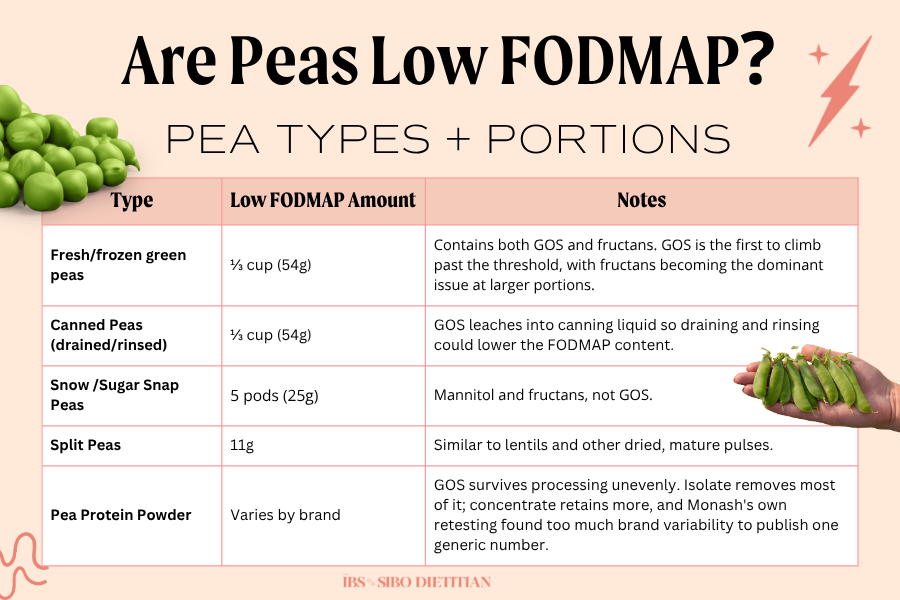
So are peas low FODMAP or not? The answer depends heavily on which form of pea you are eating, how it is prepared, and portion size. Below is how each common form compares, including pea protein powder, which has become one of the more confusing types.
Fresh and Frozen Green Peas
Low FODMAP serving: Around 1/3 cup, roughly 53 grams. Larger servings such as half a cup or more move into moderate to high FODMAP territory.
Fresh and frozen green peas behave almost identically from a FODMAP standpoint. Freezing does not meaningfully change the GOS content. Measuring your portion rather than eyeballing it is the most useful habit here, since it is easy to scoop well past a quarter cup when peas get tossed into a meal.
Canned Peas (Drained and Rinsed)
Low FODMAP serving: Around 1/3 cup, roughly 53 grams. Documented the same as fresh or frozen but could be less due to canning.
Canned peas tend to be tolerated in a somewhat larger portion than fresh or frozen. This is because GOS is water soluble and a meaningful amount can transfer into the liquid during canning. Draining and rinsing thoroughly under running water removes some of the GOS, which can stretch your tolerance slightly further.
Snow Peas and Sugar Snap Peas
Low FODMAP serving: 5 pods (25g). Mannitol and fructans, not GOS.
You’re eating pod tissue rather than mature seeds, so the FODMAP profile is different from green peas. These forms of pea is largly mannitol and fructans and not as much of a legume, lessening the GOS content.
Split Peas
Low FODMAP serving: 11g of dried peas.
Split peas are more mature and concentrated than fresh green peas, so they carry a heavier GOS load. Similar in composition as dried lentils or beans, rather than a scoop of garden peas.
Pea Protein Powder
Low FODMAP serving: No single serving applies across brands. Tolerance depends on the specific product and how it was processed.
Pea protein is where things get complicated, and this is a spot Monash has actually reversed course on. Monash previously listed a generic pea protein as low FODMAP serving. However, that was then removed after testing a range of packaged 100 percent pea protein products and finding significant variability in FODMAP content between brands (Monash University FODMAP Blog, 2024). That variability comes down to processing. A true isolate strips out most of the carbohydrate, including GOS. Concentrate on the other hand, retains more of the original pea’s fermentable sugar load. Labels rarely spell out isolate versus concentrate clearly, so the safest approach is to look for a product certified low FODMAP, rather than assuming any powder labeled pea protein is automatically safe.
Low FODMAP Swaps to Peas
If peas are not agreeing with you right now, or you are still working through reintroduction, these swaps let you keep similar flavor and texture without the same GOS load.
- Green beans: A low FODMAP vegetable that adds similar color and crunch to a stir fry or pasta dish without contributing meaningful GOS.
- Zucchini, diced small: Mimics the bite sized texture peas add to grain bowls and soups, and is well tolerated in typical low FODMAP servings.
- Water chestnuts: Add a similar light crunch to snow peas in a stir fry, with a lower FODMAP load per serving.
- Bok choy or spinach: A leafy swap for split pea soup that keeps the dish hearty without the concentrated GOS of split peas.
- Rice, hemp, or egg white protein powder: A more predictable swap for pea protein powder, since these options do not carry the same brand to brand FODMAP variability seen with pea protein (FODMAP Everyday, 2025).
How to Add Peas Back In Without Triggering Symptoms
If you suspect peas have been part of your symptom pattern, this is the process I walk clients through.
- Start with a small, measured portion, such as one to two tablespoons of peas, rather than a full serving straight away.
- Eat peas alongside a full meal that includes protein and fat, since eating any fermentable carbohydrate alongside other food slows the rate it reaches the colon and often reduces symptoms.
- Track how you feel over the following one to two days, since gas related symptoms from GOS fermentation are not always immediate.
- If the small portion is well tolerated, slowly increase the amount over several exposures rather than jumping straight to a full cup.
- Avoid combining peas with other high GOS or fructan foods, like lentils, chickpeas, or wheat, while you are still establishing your personal threshold.
- If symptoms continue even at small portions, that is a signal to look upstream at gut motility, bacterial overgrowth, or nervous system regulation rather than assuming peas themselves are the sole problem.
- Work with a registered dietitian to personalize serving sizes rather than following generic online charts, since tolerance varies significantly between individuals and can shift over time.
Bottom Line
If peas cause symptoms, the goal is not to cut them out and move on. Peas are a dose dependent food, not a forbidden one. The GOS they contain is the same carbohydrate family that causes symptoms with lentils, chickpeas, and beans. Long term relief usually requires a broader approach focused on digestion, gut motility, and nervous system regulation. Eliminating food after food will not get you to the root cause of why your gut reacts this way.
Frequently Asked Questions
Are peas a high FODMAP food?
Peas are not uniformly high FODMAP. They are dose dependent because of their GOS content, the same carbohydrate family found in lentils, chickpeas, and beans. A small, measured serving is generally well tolerated by most people on a low FODMAP diet. A full cup or more can move well into moderate or high FODMAP territory. Portion size is more important with peas than with a food that stays low FODMAP at any amount.
Can I eat peas if I have SIBO?
Many people with SIBO can tolerate a small portion of peas. Individual tolerance depends on how significant the overgrowth is and how sensitive your gut feels right now. SIBO already involves excess fermentation happening in the wrong place. The safest approach is to treat peas like any other GOS containing legume. Start small, track your response, and adjust based on your own threshold.
Is pea protein powder okay for IBS?
Pea protein powder can be tolerated by some people with IBS. The amount of GOS that survives processing varies by brand and manufacturing method. That means it is not automatically safe just because it is plant based. If you rely on pea protein regularly, pay attention to how much you use per serving. Track how your body responds over a few days rather than assuming it is gut friendly by default.
Do canned peas have less FODMAP content than fresh peas?
Canned peas, drained and rinsed, generally allow a larger low FODMAP serving than fresh or frozen peas. GOS is water soluble, so a portion of it leaches into the canning liquid. Rinsing thoroughly under running water reduces the remaining GOS content further.
How many peas are safe if I have IBS?
There is no single number that applies to everyone, since tolerance depends on the severity of your IBS, how sensitized your gut currently is, and what else is in your meal. A small, measured portion such as one to two tablespoons is a reasonable starting point for most people, with room to increase gradually if that amount is well tolerated over several exposures.