If you have been dealing with chronic bloating, reflux, constipation, diarrhea, excessive gas, or food sensitivities for years, you may have been told it is “just IBS.” If you are like many of my clients though, that diagnosis has gotten you no where. You may be wondering whether bacterial overgrowth is playing a role in your symptoms. The SIBO breath test can be an incredibly helpful clinical tool, but understanding what it actually measures, and how to interpret the results properly, is often far more complicated than most people realize.

As a Registered Dietitian specializing in IBS and SIBO, I often get asked about SIBO breath testing, especially by people trying to dig deeper into their persistent digestive symptoms. In this post, we will break down what SIBO actually is, the different gases involved, how SIBO breath testing works, the differences between lactulose and glucose testing, and when testing is appropriate.
What Is SIBO?
SIBO stands for Small Intestinal Bacterial Overgrowth, a condition where excessive bacteria begin accumulating within the small intestine. Under normal circumstances, the small intestine contains relatively low concentrations of bacteria compared to the large intestine. The majority of our gut bacteria are designed to live in the colon, where fermentation naturally occurs.
Problems begin when bacteria start accumulating in the small intestine, where they do not belong in large amounts. Once this happens, these bacteria begin fermenting carbohydrates too early during digestion. Instead of the body properly digesting and absorbing nutrients, fermentation begins prematurely. The result is often a wide range of symptoms including gas production, bloating, abdominal discomfort, and changes in bowel habits.
One of the biggest misconceptions I see is people viewing SIBO as the root cause to their symptoms itself. In reality, SIBO is rarely something that simply happens on its own. More often, bacterial overgrowth develops as a downstream consequence of deeper dysfunction involving:
- Impaired motility
- Poor digestion
- Low stomach acid
- Structural abnormalities
- Post infectious IBS
- Nervous system dysregulation
- Other factors that interfere with how the digestive system normally functions
The Three Gases Associated With SIBO
When bacteria begin fermenting carbohydrates inside the small intestine, they produce gases that can contribute to very different symptom patterns depending on which microbes are involved. The symptoms people experience are not coming from bacteria themselves, but from the gases these microbes produce during fermentation.
Hydrogen
Certain bacteria produce hydrogen gas when they ferment carbohydrates. Hydrogen dominant overgrowth often causes bloating, excessive gas, diarrhea, urgency, and looser bowel movements. Because hydrogen itself tends to move more quickly through the digestive tract, it often correlates with faster transit patterns (diarrhea).
Methane
Methane is slightly different because methanogens, not bacteria themselves, produce it. Clinicians now more accurately refer to this as Intestinal Methanogen Overgrowth, or IMO.
Methane overgrowth strongly correlates with constipation, slower motility, hard stools, and more severe abdominal distension. Research has shown that methane directly slows intestinal transit time, helping explain why constipation so commonly accompanies methane overgrowth (Pimentel et al., American Journal of Physiology, 2006).
Hydrogen Sulfide
Sulfur reducing bacteria produce hydrogen sulfide, a newer area of research within SIBO testing. This type of overgrowth often causes diarrhea, urgency, burning sensations, food intolerances, and in some cases a strong sulfur or rotten egg smell. Research has linked hydrogen sulfide producing bacteria more closely with diarrhea predominant symptom patterns, but in some cases can present as constipation (Villanueva-Millan et al., American Journal of Gastroenterology, 2022).
Because hydrogen sulfide testing is relatively new, it remains one of the more challenging gases to identify accurately.
How Does a SIBO Breath Test Work?
Currently, the SIBO breath test remains the primary non invasive tool we have available for identifying small intestinal bacterial overgrowth, but I think it is important to understand that testing is far more nuanced than many people realize. While breath testing can absolutely provide helpful clinical information, no test is perfect, and understanding the limitations of testing is just as important as understanding the results themselves.
Unlike many diagnostic tests that directly measure a specific marker in the body, SIBO breath testing works indirectly. Rather than measuring bacterial overgrowth itself, the test measures gases produced when bacteria ferment certain carbohydrates inside the digestive tract. The body absorbs these gases into the bloodstream and carries them to the lungs, where repeated breath samples collected over several hours ultimately measure them.
A clinical review published by the American College of Gastroenterology emphasized that breath testing remains our primary diagnostic tool. The same review noted that variability in sensitivity, specificity, preparation protocols, and interpretation methods continues to create significant limitations when diagnosing bacterial overgrowth (Rezaie et al., The American Journal of Gastroenterology, 2017).
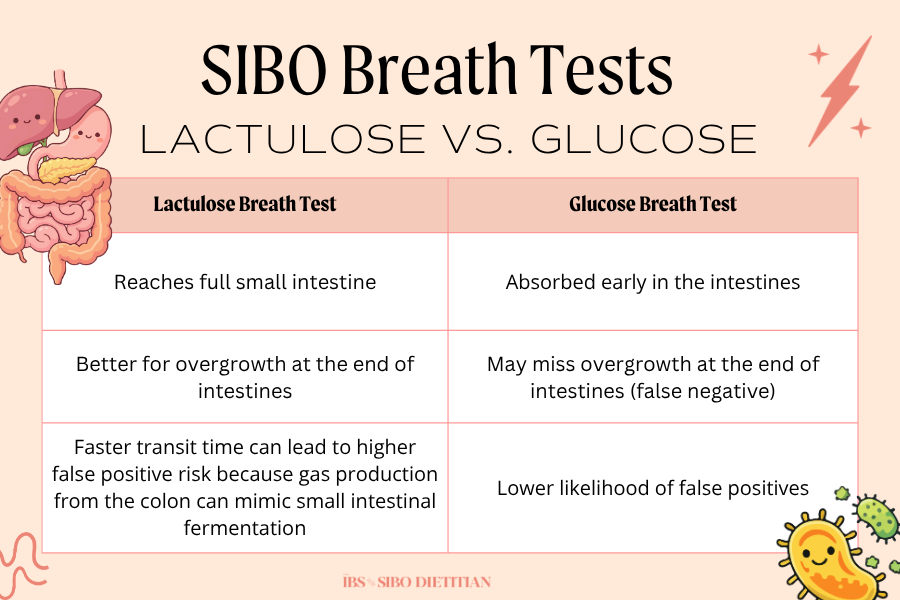
Currently, the two most commonly used breath tests rely on either lactulose or glucose as the testing substrate. Both work by measuring fermentation gases, but each option comes with very different strengths and weaknesses that can significantly impact interpretation.
Lactulose Breath Testing
Lactulose testing uses a synthetic lactulose sugar that passes through the digestive tract without being absorbed. Because lactulose continues traveling through the entire small intestine before eventually reaching the colon, it has the potential to identify bacterial overgrowth occurring further downstream that may otherwise be missed.
Advantages of Lactulose Testing
- Reaches the full length of the small intestine
- More likely to detect distal (lower) small intestinal overgrowth
- Can capture fermentation patterns that glucose testing may miss
This is one of the major advantages of lactulose testing. If bacterial overgrowth exists in the distal portion of the small intestine, lactulose is more likely to detect fermentation occurring in those later segments compared to other testing methods.
Limitations and Challenges
The downside, however, is where interpretation becomes much more complicated. Once lactulose reaches the large intestine, fermentation begins occurring where it should. Colonic bacteria naturally begin producing gas, which increases the likelihood of false positive results.
- Gas production from the colon can mimic small intestinal fermentation
- Higher risk of false positives compared to glucose testing
- Interpretation becomes more dependent on timing and clinical context
This becomes especially problematic when transit time is slower. It is also a concern when clinicians interpret results too aggressively without considering the full clinical picture. Current clinical guidelines repeatedly discuss this challenge when covering breath test interpretation (Rezaie et al., The American Journal of Gastroenterology, 2017).
Glucose Breath Testing
Glucose testing works somewhat differently because the body rapidly absorbs glucose in the upper portion of the small intestine shortly after ingestion. Because of this early absorption, there is significantly less opportunity for normal colonic fermentation to interfere with the test.
Advantages of Glucose Testing
A systematic review and meta-analysis found glucose breath testing to be more specific than lactulose testing, with a lower risk of false positive results (Losurdo et al., Journal of Neurogastroenterology and Motility, 2020). This is one of the reasons I often prefer glucose testing in practice.
- Higher specificity compared to lactulose
- Lower likelihood of false positives
- Less interference from normal colonic fermentation
Limitations and Challenges
The limitation, however, is that glucose does not travel through the entire length of the small intestine. If bacterial overgrowth exists further downstream, the body may absorb the substrate long before it reaches that portion of the digestive tract. This means the test could completely miss bacterial overgrowth that is still present.
- May miss distal (lower small intestine) overgrowth
- Absorption occurs before reaching the full length of the small intestine
- Negative results do not always rule out SIBO
This is where things become more complicated because a negative test result does not always mean SIBO has been fully ruled out.
Lactulose vs Glucose: Which Is Better?
The reality is that neither test substrate is perfect but at this time, breath testing is still the gold standard of SIBO diagnosis. The goal should be understanding what each test can and cannot tell us while interpreting results within the context of the client’s clinical presentation.
When Should You Test for SIBO?
Breath testing is often most appropriate when symptoms strongly suggest abnormal fermentation may be occurring within the small intestine.
This commonly includes symptoms such as:
- Persistent bloating that starts a couple hours after meals and progressively worsens throughout the day
- Excessive belching or gas production
- Chronic constipation or diarrhea
- Food intolerances that seem to be progressively worsening
- Symptoms that worsen after consuming fermentable carbohydrates (FODMAPs)
- Recurrent symptoms after previous successful antibiotic treatment
- Digestive symptoms that developed after food poisoning or gastrointestinal infection
- Ongoing reflux that seems closely connected to abdominal bloating and distension
That said, I do not believe every digestive symptom automatically requires immediate SIBO testing.
There are situations where focusing first on digestion, meal patterns, nervous system regulation, motility support, or identifying other root causes may provide more valuable information before jumping directly into testing.
Why Symptoms and Clinical Judgment Should Be Prioritized
While breath testing can absolutely be helpful, we have to acknowledge that both sensitivity (true postitive) and specificity (true negative) remain imperfect. And in many situations, test results alone do not tell the entire story.
This is why I spend significant time looking beyond the test itself and focusing on the bigger clinical picture; symptom presentation, digestive function, and bowel patterns. I also look deeply into past medical history, medication use, history of food poisoning, surgical history, and overall motility patterns. Together, these often provide just as much valuable information as the breath test itself.
Too often, people become hyper focused on finding the perfect test result while overlooking the physiology that is driving symptoms in the first place.When we zoom out and look at the bigger picture, testing becomes one piece of the puzzle rather than the entire answer.
A positive breath test can tell us bacterial fermentation may be occurring in the small intestine, but it does not explain why bacterial overgrowth developed in the first place. The deeper question should always be what underlying dysfunction allowed the overgrowth to happen. Because as I say over and over, SIBO itself is not the root problem. Instead it is the symptom of something bigger involving digestion, motility, nervous system regulation, structural abnormalities, or other disruptions affecting how the digestive system functions as a whole.

Final Thoughts
If you suspect SIBO, the SIBO breath test can provide valuable clinical information, but it works best alongside the full clinical picture rather than in isolation. Symptoms, digestive function, motility patterns, prior health history, and underlying physiology often tell us just as much as the test itself. This is exactly where conventional approaches tend to fall short.
A positive or negative result is a starting point, not a final answer. The right test, interpreted well, gives you a clearer picture of what is actually happening in your gut, so you and your provider can build a plan that fits your symptoms rather than a generic protocol.
Frequently Asked Questions
Can you have SIBO with a negative breath test?
Yes. False negatives can occur depending on where bacterial overgrowth exists within the digestive tract, transit time, preparation errors, and limitations within the testing substrate itself. A negative result does not always completely rule out bacterial overgrowth.
Which SIBO breath test is better, lactulose or glucose?
Neither is universally better. Glucose tends to have higher specificity and fewer false positives, while lactulose can identify overgrowth further down in the small intestine (Losurdo et al., 2020). The right test often depends on the individual clinical picture.
Do you always need a SIBO breath test before treatment?
Not necessarily. While testing can be extremely helpful, symptoms, health history, and understanding digestive physiology often provide equally valuable information when building a treatment plan.
Can SIBO come back after treatment?
Yes. Research shows that more than a third of patients experience a return of bacterial overgrowth within a year of successful antibiotic treatment, especially when contributing factors are left unaddressed (Lauritano et al., American Journal of Gastroenterology, 2008). This is one of the biggest reasons focusing only on eliminating bacterial overgrowth often fails long term. If the underlying issue affecting digestion or motility is not addressed, recurrence becomes much more likely.
Ready to Move Beyond Testing and Actually Heal?
A SIBO breath test can point you in the right direction, but testing alone will not resolve why the overgrowth happened in the first place. Maybe you have already tested, treated, and relapsed. Maybe you are just tired of guessing what your gut actually needs. Either way, my Bloating Breakthrough Coaching Program is built to help you dig past the test result. Together we look at motility, nervous system regulation, and digestive patterns, the pieces that keep symptoms cycling back. The goal is to help you eat with confidence again, instead of managing symptoms indefinitely.
Learn more about the Bloating Breakthrough Coaching Program →